

A construction project can start with the best drawings, a strong budget, and a capable team. It can still run into trouble if the client chooses the wrong procurement route.
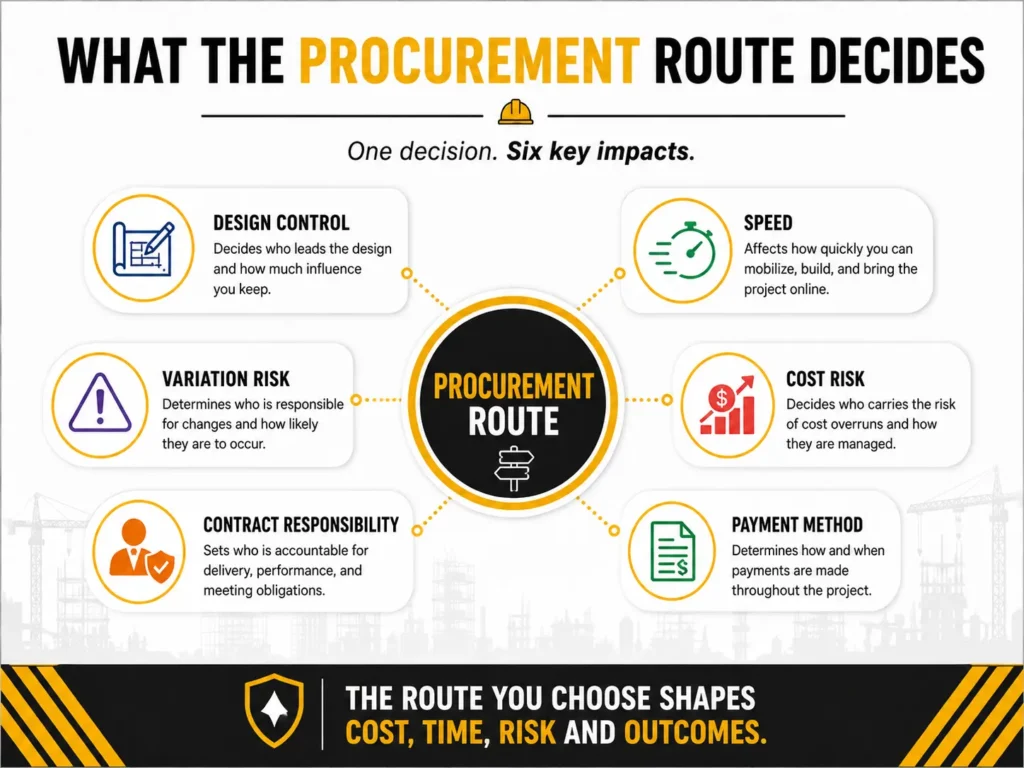
The procurement route decides how the project moves from idea to design, tender, contract, construction, payment, and handover. It decides who controls design, who carries cost risk, who manages subcontractors, who deals with changes, and how quickly the project can move from planning to site work.
That decision affects everyone.
The estimator prices the project based on the route. The contractor accepts risk based on the route. The consultant gives instructions based on the route. The QS measures and certifies work based on the route. The planner builds the schedule based on the route. The contracts team handles claims, notices, and variations based on the route.
Many people think procurement belongs only to the client or commercial team. That view creates a narrow understanding of construction. Every engineer should know the basics because the route shapes daily project behaviour.
A traditional design-bid-build project does not feel the same as a design-build project. A lump sum contract does not behave like an item-rate contract. A fast-track project does not carry the same risk as a fully designed tender. An EPC or turnkey project does not give the client the same level of design control as a consultant-led route.
Choosing the route is not a formality. It is one of the earliest project risk decisions.
What a procurement route actually decides
A procurement route answers a simple question:
How will the client buy the project?
That one question breaks into many smaller decisions:
- Who designs the project?
- When does the contractor join?
- Who carries design risk?
- Who controls subcontractor packages?
- How does the client pay?
- How does the team handle changes?
- How much cost certainty does the client need?
- How much speed does the project need?
- How much design control does the client want?
A project that needs strong design control may choose a different route from a project that needs speed. A client with an expert internal team may choose a different route from a client who wants a single contractor to take full responsibility. A complex hospital project may need more design development and coordination than a warehouse with a clear functional brief.
This is why no route is “best” in every situation. The right route depends on the client’s priority: cost certainty, speed, design control, risk transfer, flexibility, technical complexity, or long-term operation.
Traditional procurement: more design control, slower start
Many projects still follow the traditional route, often known as design-bid-build. In this route, the client appoints designers first. The design team prepares drawings, specifications, and tender documents. Contractors then price the completed or near-completed design. The client awards the construction contract after tender. Under design-bid-build, the owner contracts separately with the designer and the contractor, and the project moves through design, tender, and construction as separate phases.
This route can work well when the client wants strong control over design before construction starts. It also allows contractors to bid on the same design basis, which can make price comparison clearer.
But the route has one weakness: the contractor joins late. If the design carries buildability problems, pricing gaps, or coordination issues, the contractor may find them during tender or construction. That can lead to RFIs, variations, redesign, delay, or disputes.
Traditional procurement may suit:
- projects where design quality matters strongly
- clients who want consultant-led design control
- projects with a stable brief
- works where the client can wait until design reaches enough detail
- public projects that need tender comparison and clear competition
It may create strain when the client needs speed, the design keeps changing, or buildability needs contractor input early.
Design-build: one point of responsibility, less client control
Design-build changes the structure. The client appoints one party to take responsibility for both design and construction. This gives the client a single point of responsibility, and it can reduce the split between designer and contractor. Design-build also allows design and construction work to overlap, which can shorten delivery time compared with a route where the team completes design before tender.
This route suits clients who want speed, clearer responsibility, and fewer gaps between design and construction. It can work well for projects with a clear output brief, such as warehouses, industrial buildings, schools, housing blocks, and repeatable building types.
But design-build changes the client’s role. The client must define requirements clearly at the start. If the employer’s requirements stay vague, the contractor may price assumptions that do not match the client’s expectations. Once the contract starts, design changes can cost more because the contractor priced a defined responsibility.
Design-build may suit:
- projects with a clear brief
- clients who want one responsible party
- projects where speed matters
- projects where buildability and cost input should enter early
- clients who can define performance, quality, and scope clearly
It may not suit clients who want high design control throughout the process or projects where the brief keeps shifting.
EPC and turnkey: strong transfer of responsibility
EPC stands for Engineering, Procurement, and Construction. Turnkey has a similar idea in many construction conversations: the contractor takes broad responsibility and gives the client a ready-to-use asset at completion.
People often see EPC or turnkey routes in industrial, energy, infrastructure, process plant, and large technical projects. The contractor may handle design, procurement, construction, testing, and commissioning under one broad package. BOT and related PPP models also sit in this wider family where a private party may design, build, finance, operate, or transfer an asset depending on the agreement.
The main advantage is responsibility. The client can pass more risk to the contractor, especially around design, procurement, coordination, and delivery.
But risk transfer costs money. Contractors price the risk they accept. If the client’s requirements stay unclear, the project can still face claims and arguments. EPC does not remove the need for clear scope. It makes clear scope even more important.
EPC or turnkey may suit:
- technically defined projects
- industrial or infrastructure works
- clients who want a single delivery responsibility
- projects with strong output requirements
- projects where commissioning and performance matter
It can become risky when the client does not define performance, interfaces, approvals, and change rules clearly.
Construction management: more flexibility, more client involvement
Construction management works differently. The client appoints a construction manager to manage the work packages. The client usually holds the trade contracts directly, while the construction manager coordinates planning, procurement, site work, and package delivery.
This route can help when the project needs an early start, package-by-package tendering, or strong client control. It can also support complex projects where design and construction overlap.
But the client carries more risk because the construction manager does not take the same full delivery responsibility as a main contractor under a lump sum route. The client must make decisions quickly and manage more direct contractual relationships.
Construction management may suit:
- experienced clients
- fast-track projects
- projects with many packages
- projects where early works must start before full design completion
- clients who want direct control over trade packages
It may not suit inexperienced clients who want one contractor to carry full responsibility.
Management contracting: contractor input without full early design freeze
Management contracting sits between traditional procurement and construction management. The client appoints a management contractor early. The management contractor advises on buildability, packaging, planning, and cost, then lets work packages to trade contractors.
The management contractor manages the packages, but the final cost may stay less certain at the start because the project develops package by package. This route can help projects that need early contractor advice but still need flexibility during design.
It may suit:
- larger or more complicated building projects
- clients who need early contractor input
- projects where work packages need careful coordination
- projects that cannot wait for full design completion before procurement starts
It may create risk if the client expects fixed-price certainty too early.
Item-rate, lump sum, and cost-plus are not the same as procurement routes
This is where many freshers get confused.
A procurement route tells you how the project team and responsibility structure work. A pricing method tells you how the contractor gets paid.
For example, a project may use a traditional route with a lump sum contract. Another project may use an item-rate contract. Another may use cost-plus or reimbursable pricing. These choices affect how quantities, changes, and risk move during the project.
A lump sum price gives the client more cost certainty when the design and scope are clear. It can create disputes when the scope changes or drawings lack detail. An item-rate contract works better when quantities may change, because payment follows measured quantities at agreed rates. Cost-plus gives more flexibility but needs strong cost control because the client pays actual cost plus a fee.
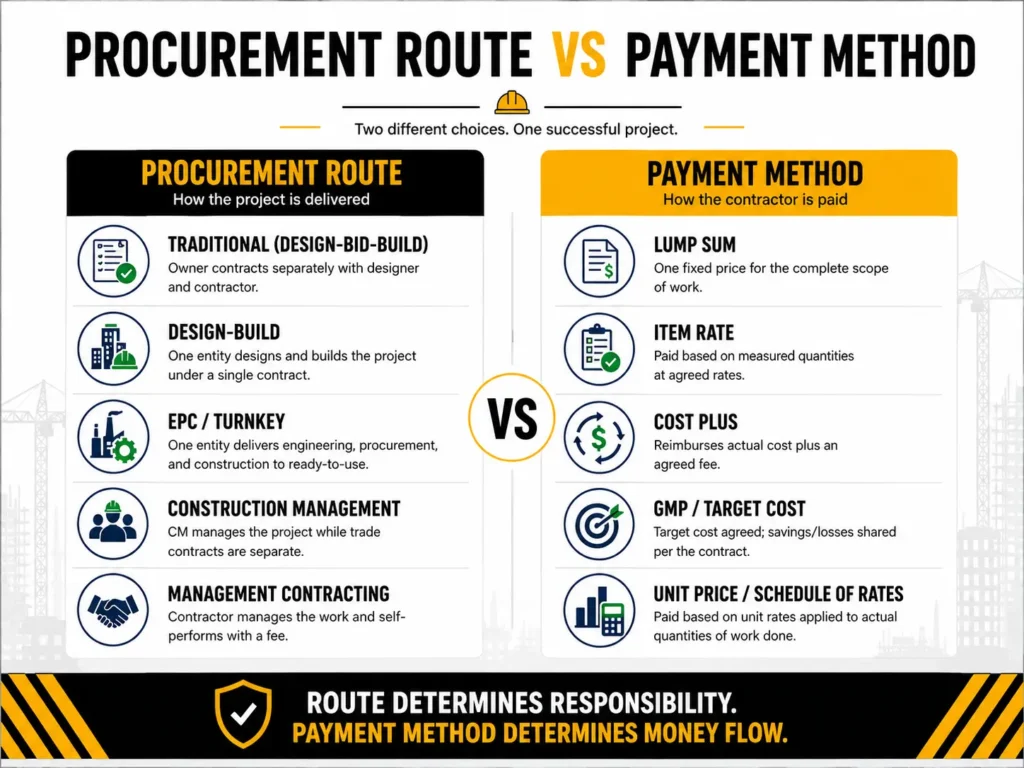
A good team looks at both together. A poor match can create trouble. A lump sum contract with incomplete design can lead to heavy variation fights. A cost-plus contract without cost control can drain the budget. An item-rate contract with weak measurement discipline can damage billing and cash flow.
A practical example: when the route does not match the project
Imagine a client wants to build a hospital extension. The project has live hospital operations, MEP-heavy coordination, infection control concerns, strict access limits, and many stakeholder approvals.
If the client chooses a route only because it gives the lowest tender price, the project may suffer later. A traditional lump sum route may look attractive if the design seems complete. But if the hospital keeps changing requirements or MEP coordination needs contractor input, the project may face RFIs, claims, change orders, and delay.
In this case, the client may need early contractor involvement, design-build with a very strong brief, or management-style packaging where buildability enters earlier. The right answer depends on the client’s team strength and appetite for risk.
Now imagine a simple warehouse project with clear layout, standard materials, and repeatable construction. A design-build or lump sum route may work better because the client can define the output clearly and move quickly.
This is the real point: the project should choose the route, not the other way around.
How the route changes the engineer’s work
Procurement routes do not stay inside contract files. They change daily engineering work.
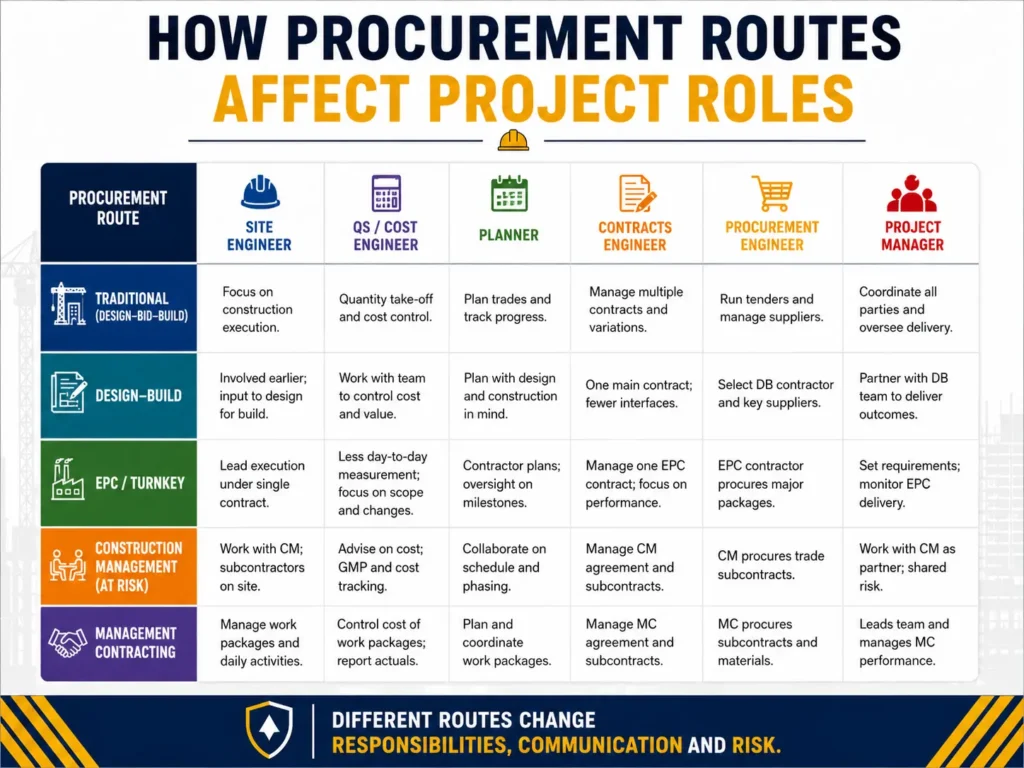
In a traditional route, site engineers may deal with consultant instructions, drawing clarifications, and variations linked to design gaps. Planners may track delays caused by late information or approvals. QS teams may spend more time managing measured work and change records.
In a design-build route, engineers may work closer with design teams because the contractor carries design responsibility. BIM coordination, design management, and technical submittals may become more important.
In EPC or turnkey projects, engineers may face stricter performance requirements, commissioning obligations, vendor package control, and interface risk. Procurement teams often carry heavy responsibility because long-lead equipment can drive the entire project.
In construction management or management contracting, engineers may coordinate many packages directly. The site team needs strong communication because multiple trade contractors may move at once under separate packages.
This is why young professionals should learn procurement routes early. The route explains why the project behaves the way it does.
How to choose the right route
A client should never choose a route based on habit alone. The decision should come from project priorities.
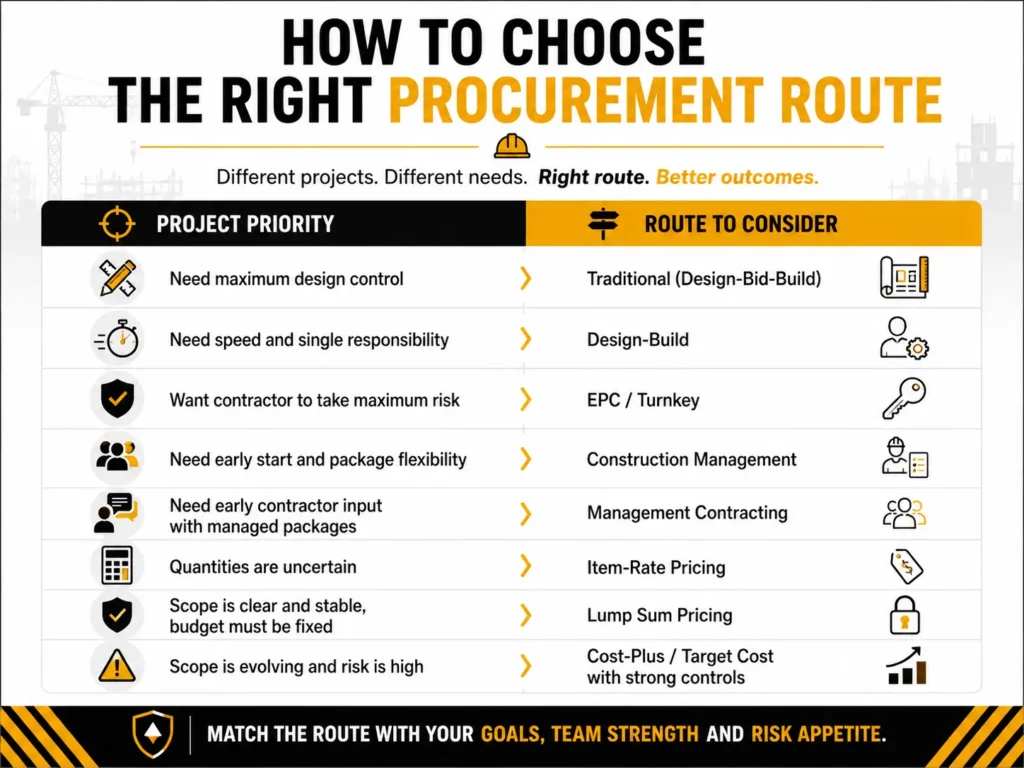
This table does not give final answers. It gives a starting point. Every project still needs legal, commercial, technical, and risk review before the client signs a contract.
Final takeaway
The procurement route shapes the project long before construction starts. It decides how design, cost, risk, payment, responsibility, and decision-making move through the project. When the route matches the project, teams get clearer roles and fewer avoidable conflicts. When the route does not match, even a good team may spend the project fighting the structure.
Students and young engineers should understand this early. Procurement routes explain why some projects move slowly, why some clients push risk to contractors, why some variations become disputes, and why some teams need heavy documentation from day one.
For learners who want to grow into estimation, QS, billing, procurement, contracts, project controls, or project management roles,Construction Learning can help build the role-based understanding behind these decisions. Construction careers grow faster when people understand not just how work gets done, but how projects get bought, priced, managed, and protected.
References
- Design-build overview
https://en.wikipedia.org/wiki/Design%E2%80%93build - Design-bid-build overview
https://en.wikipedia.org/wiki/Design%E2%80%93bid%E2%80%93build - Construction management overview
https://en.wikipedia.org/wiki/Construction_management - Early contractor involvement overview
https://en.wikipedia.org/wiki/Early_contractor_involvement - Build-operate-transfer and PPP delivery models
https://en.wikipedia.org/wiki/Build%E2%80%93operate%E2%80%93transfer - Lump sum contract overview
https://en.wikipedia.org/wiki/Lump_sum_contract - Construction bidding and procurement methods
https://en.wikipedia.org/wiki/Construction_bidding