

Estimation is one of the most misunderstood career paths in construction.
Many students think it means “calculate quantities.” Some fresh engineers think it means preparing Excel sheets. Some people treat it as a back-office task that happens before the real project begins.
That view misses the point.
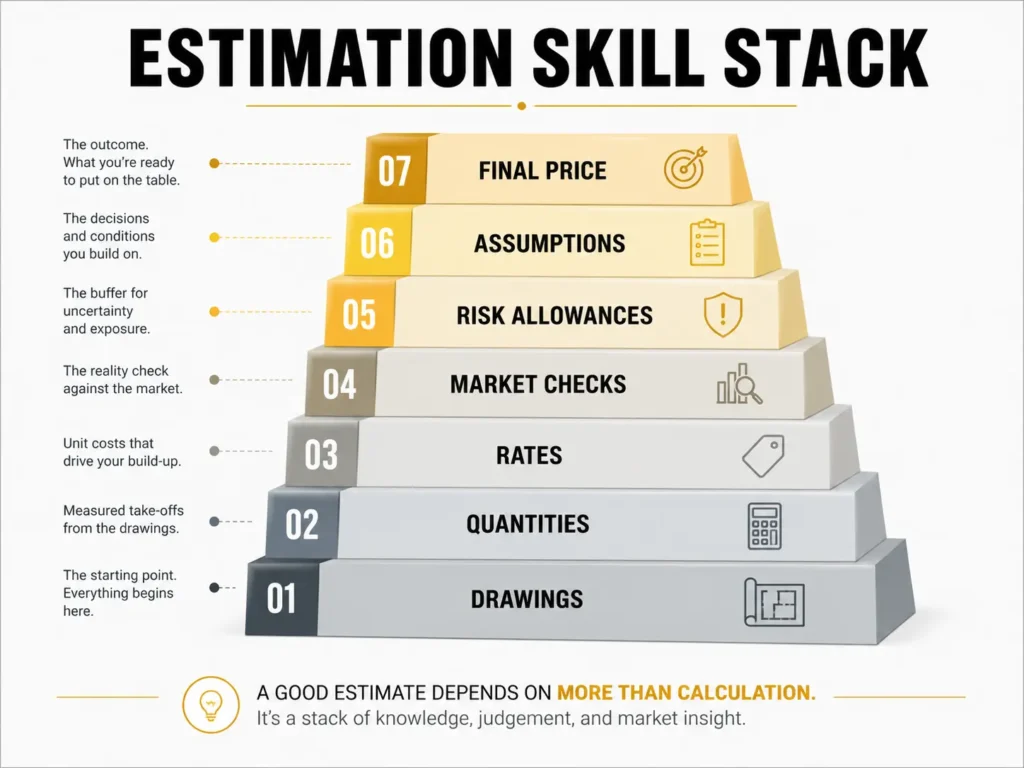
A good estimator helps decide whether a project starts with a clear commercial base or a weak one. Before site teams execute work, before procurement starts buying material, before contracts teams negotiate terms, someone must read the drawings, understand the scope, calculate quantities, check rates, compare vendor prices, add risk allowances, and turn all of that into a price the company can stand behind.
That is estimation.
It sits at the point where drawings become money.
Autodesk’s 2025 State of Design & Make report says 58% of AECO leaders see lack of skilled talent as a barrier to growth, while 61% of civil infrastructure leaders say they struggle to find new employees with the right technical skills. Estimation fits directly into that skills problem because companies do not only need people who can prepare numbers. They need people who understand scope, cost, risk, and project reality.
Estimation starts before the site sees the work
A project often begins as drawings, specifications, tender documents, site information, and commercial conditions. The estimator must turn those inputs into a cost picture.
That work shapes major decisions:
- Should the company bid for the project?
- What will the work actually cost?
- Where does the scope look unclear?
- Which items need vendor or subcontractor quotes?
- What risks may affect cost later?
- What exclusions or assumptions should the bid mention?
- What price gives the company a real chance without creating a loss?
A weak estimate can hurt a project before work begins. If the estimator misses a scope item, the team may carry the cost later. If labour productivity looks too optimistic, execution may struggle to match the price. If material escalation gets ignored, procurement may face pressure. If preliminaries look too low, site overheads may eat into margins.
Estimation does not only predict cost. It protects the company from entering the project blindly.
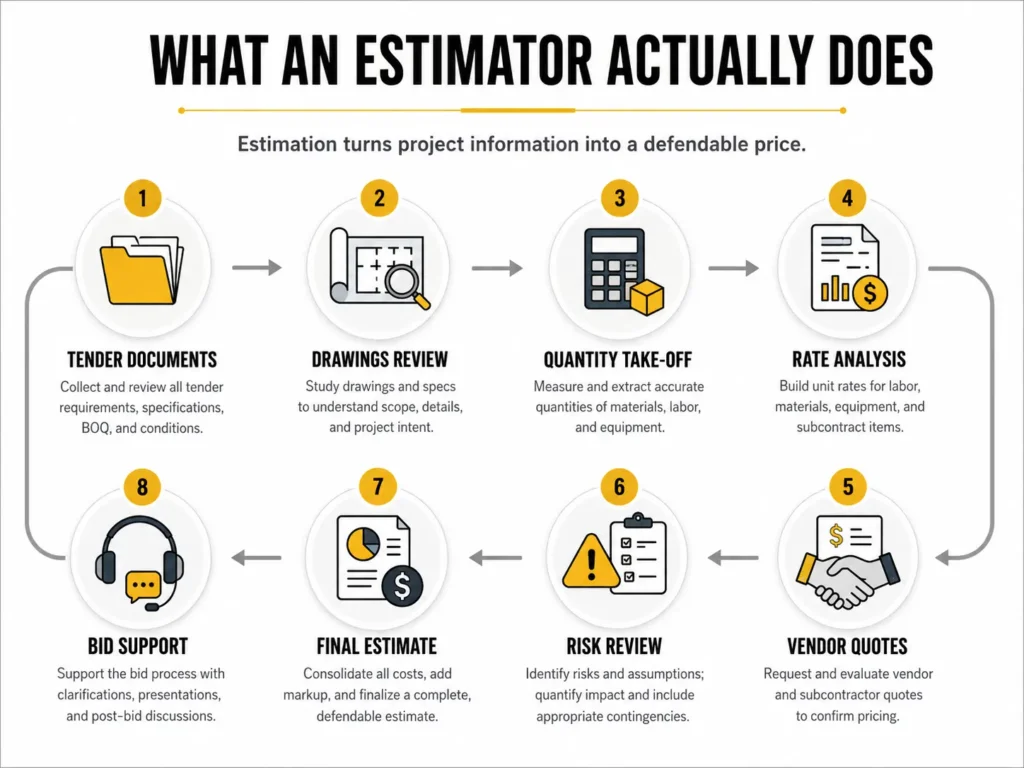
What an estimator actually does
An estimator does not spend the whole day doing one calculation. The role moves between technical reading, quantity work, market checking, commercial thinking, and communication.
A typical estimator may:
- study drawings, specifications, and tender documents
- identify the scope of work
- prepare quantity take-offs
- review BOQs or prepare BOQ items
- check rates for labour, material, equipment, and subcontract work
- request vendor and subcontractor quotes
- compare quotations
- add preliminaries, overheads, contingencies, and margins
- prepare assumptions and exclusions
- support tender clarification
- hand over estimate logic to execution, QS, planning, and procurement teams
The BOQ plays a major role in many tenders. A bill of quantities lists work items and quantities so bidders can price the same scope on a common basis. It helps tenderers calculate construction costs and gives the client a fairer way to compare bids.
But a BOQ does not remove judgment. An estimator still needs to check whether the BOQ matches the drawings, whether the specification changes the item, whether a quantity looks unusual, and whether the rate makes sense for the location and project condition.
The real skill: reading scope before pricing it
Most estimation mistakes start before the number.
They start with scope.
A fresher may look at a drawing and calculate quantities. A better estimator first asks what the work includes, what it excludes, what remains unclear, and what conditions may change the cost.
For example, two flooring items may look similar in a BOQ. One may include surface preparation, adhesive, skirting, wastage, and protection. Another may list only the finished flooring material. If the estimator prices both as if they carry the same scope, the bid may carry a hidden loss.
The same problem appears in excavation, concrete, waterproofing, façade, MEP sleeves, finishing, temporary works, and site preliminaries. The number only helps after the estimator understands the work behind it.
This is why estimation needs drawing sense and site sense. A person who has seen work on site can often price more carefully because they know where labour slows down, where wastage happens, where access creates difficulty, and where drawings hide practical problems.
A tender-room situation freshers should understand
Picture a contractor preparing a bid for a mid-size commercial building.
The estimator receives architectural drawings, structural drawings, specifications, tender conditions, and a BOQ. The deadline sits two weeks away. The company wants a competitive price, but it cannot afford a loss-making bid.
The first problem appears in the drawings. The façade detail changed in one drawing, but the BOQ still carries the older description. The second problem appears in the specification. It asks for a higher-grade waterproofing system than the BOQ item suggests. The third problem comes from the site condition. The project sits in a congested area, so material movement and storage will cost more than a normal project.
A weak estimator may price the BOQ line by line and move on.
A good estimator flags the façade mismatch, raises a clarification, adjusts the waterproofing rate, checks logistics cost, and records assumptions. They may also speak with procurement for updated material prices and ask planning for the likely duration of preliminaries.
That is the difference between estimation as calculation and estimation as commercial thinking.
Key skills every construction estimator needs
Estimation rewards people who can combine detail with judgment. The role does not suit careless work. A small missed item can affect large money later.
| Skill | Why it matters |
| Drawing reading | Helps the estimator understand what the project actually requires |
| Quantity take-off | Turns drawings into measurable work quantities |
| BOQ understanding | Helps connect scope, units, descriptions, and pricing basis |
| Rate analysis | Breaks down labour, material, equipment, subcontract, overhead, and margin |
| Vendor comparison | Checks whether quoted rates match scope and market conditions |
| Specification reading | Catches quality, material, method, and performance requirements |
| Site condition awareness | Adjusts pricing for access, logistics, productivity, and risk |
| Assumptions and exclusions | Protects the bid from unclear or unpriced scope |
| Communication | Helps estimators clarify issues with design, procurement, planning, and commercial teams |
Estimation does not need dramatic language. It needs careful reading and clean thinking.
Tools matter, but tools do not replace estimating judgment
Estimators use tools every day. Excel still plays a large role in many companies. AutoCAD, Bluebeam, CostX, PlanSwift, Revit, BIM-based quantity tools, ERP systems, and cost databases may also support the work depending on the company.
Digital take-off tools can save time. BIM can help extract quantities when the model carries reliable information. Cost databases can support rate checks. Estimating software can structure items, quotes, comparisons, and revisions.
But tools only help when the estimator understands the input.
If the drawing has a revision issue, the software will not fix the commercial risk by itself. If the BIM model lacks correct information, extracted quantities can mislead the team. If the rate database does not match local market conditions, the estimate may still fail. If the estimator does not understand scope, a polished output can still carry a bad price.
AACE cost estimate classification systems show how estimate accuracy depends on project definition. Early-stage estimates work with limited information. Later-stage estimates need more defined scope and stronger detail. This matters because estimators must know the confidence level behind the number, not only the number itself.
Estimation connects with other construction roles
Estimation does not end when the company submits the bid. A good estimate can support the project after award.
The execution team needs to know what the estimator assumed. Procurement needs vendor quotes and rate logic. QS and billing teams need BOQ structure and quantity basis. Planning teams need duration assumptions and preliminaries. Contracts teams need exclusions, clarifications, and tender conditions. Project managers need to know where the estimate looks tight.
When companies treat estimating as a closed file, projects suffer. The site team may not know which assumptions shaped the bid. Procurement may not know which vendor quote supported the price. Billing may not know which item carried risk. Planning may not know why the preliminaries looked low.
A strong estimate should move into a clear handover.
That handover may include:
- priced BOQ
- rate build-ups
- vendor and subcontractor quote comparisons
- assumptions and exclusions
- risk items
- clarifications
- scope gaps
- key quantities
- preliminaries basis
- margin and contingency notes, where the company permits sharing
This helps the project avoid relearning the tender from scratch.
Growth path in estimation
A career in estimation can grow in many directions. It can stay inside preconstruction, move into QS and commercial management, or connect with project controls and contracts.
A typical path may look like this:
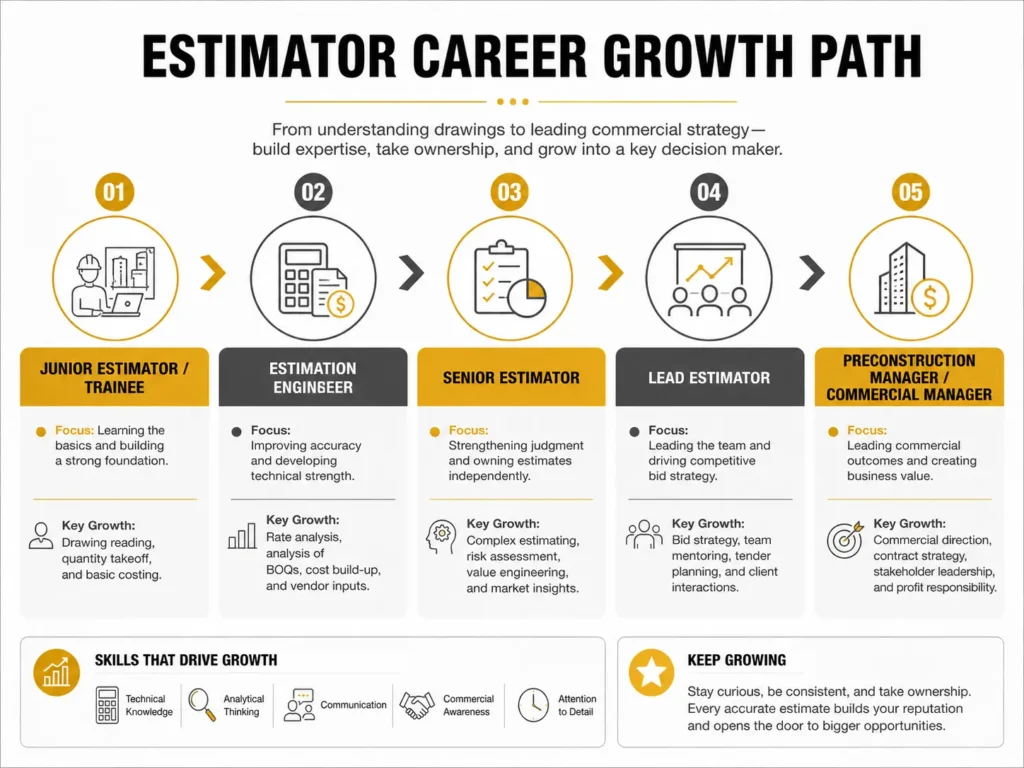
Some estimators also move into QS, billing, procurement, planning, contracts, or project controls because estimation gives them a strong view of drawings, cost, scope, and risk.
This is why estimation can work well for fresh engineers who like both technical and commercial thinking. It teaches them how a project becomes financially possible.
What freshers should learn before choosing estimation
Freshers do not need to master everything on day one. They need a clear starting base.
A good early learning path should include:
- how to read architectural and structural drawings
- how to measure basic quantities
- how BOQ units work
- how item descriptions change scope
- how to prepare simple rate analysis
- how labour, material, equipment, wastage, overhead, and margin enter a rate
- how to compare vendor quotes
- how to write assumptions and exclusions
- how to spot drawing and BOQ mismatches
- how site conditions affect productivity and cost
The best practice starts small. Take one activity, such as blockwork, plastering, concrete, waterproofing, or flooring. Read the drawing. Measure the quantity. Check the specification. Build the rate. Add wastage. Think about labour productivity. Then write the assumption clearly.
That exercise teaches more than a random certificate.
Why estimation needs role-based learning
Generic construction training often treats estimation as a chapter. That does not build career readiness.
An estimator needs a different skill path from a site engineer or planning engineer. They need stronger cost logic, BOQ understanding, vendor comparison, scope reading, and tender discipline. They also need enough site sense to avoid pricing work like a clean classroom problem.
This is where role-based learning matters. It can help learners move from “I know estimation formulas” to “I can understand what a real estimator checks before pricing a job.”
For learners who want to explore estimation as a serious career path,Construction Learning brings role-based courses, career tools, webinars, jobs, and expert-led learning into one construction-focused platform. A good estimation career does not start with software alone. It starts with understanding drawings, quantities, rates, scope, and risk well enough to price work with confidence.
References
- Autodesk State of Design & Make 2025: AECO insights
https://www.autodesk.com/design-make/research/state-of-design-and-make-2025/industry - Autodesk State of Design & Make 2025: skilled talent gap
https://www.autodesk.com/design-make/research/state-of-design-and-make-2025/skilled-talent-gap - RICS: What is a quantity surveyor?
https://www.rics.org/surveyor-careers/surveying/what-surveyors-do/what-is-a-quantity-surveyor - AACE International: Cost estimate classification system reference
https://web.aacei.org/resources/recommended-practices - Bill of quantities overview
https://en.wikipedia.org/wiki/Bill_of_quantities - Cost estimate overview and estimate classifications
https://en.wikipedia.org/wiki/Cost_estimate