

A construction claim rarely begins with a formal claim document.
It often begins much earlier.
A drawing arrives late. A client asks for extra work. A subcontractor loses access to an area. An approval sits pending. A site instruction changes the work. A team works overtime to recover a delay that someone else caused.
At that moment, the project may still look normal. People may say, “We will sort it out later.” Site teams may continue the work. The engineer may update the senior casually. The planner may mark a delay in the schedule. The QS may wait for backup. The contracts team may hear about the issue only after two weeks.
By then, the project may already have lost its strongest position.
That is why engineers need to understand contracts and claims early. Not because every engineer must become a legal expert. Not because every site issue should turn into a fight. Engineers need contract awareness because their daily records often decide whether the project can prove time, cost, scope, and responsibility later.
FIDIC-style contracts show how serious this can become. Under FIDIC 1999 Red Book Sub-Clause 20.1, the contractor must give notice to the Engineer “not later than 28 days” after becoming aware of the event or circumstance giving rise to the claim. FIDIC 2017 keeps a similar 28-day notice concept for claims for payment or extension of time. The exact contract always matters, but the principle stays clear: timing can decide entitlement.
Contracts are not only for the commercial team
Many young engineers treat the contract as something that sits with the management, QS, billing, or legal team. That thinking creates risk.
The contract shapes daily site work. It explains scope, timelines, payment rules, variation process, notice requirements, approval routes, quality obligations, delay responsibilities, and dispute steps. A site engineer may not draft the contract, but the site engineer often creates the facts that support or damage a later claim.
For example, a site engineer may receive an instruction to change the location of a wall opening. If they do not record who gave the instruction, when it came, which drawing changed, what work got affected, and how much labour or material the change caused, the QS and contracts team may struggle later.
The project may have a real claim. The team may still lose it because the records do not prove it.
RICS explains that construction contracts often contain express terms that give parties rights to claim time or money, such as extension of time provisions, loss and expense provisions, or variation-related payment rights. These rights depend on the contract wording and the process the contract sets.
This means engineers do not need to read contracts like lawyers. They need to understand what their actions affect.
A claim starts with an event, not a document
A claim usually grows from a project event. The formal submission comes later.
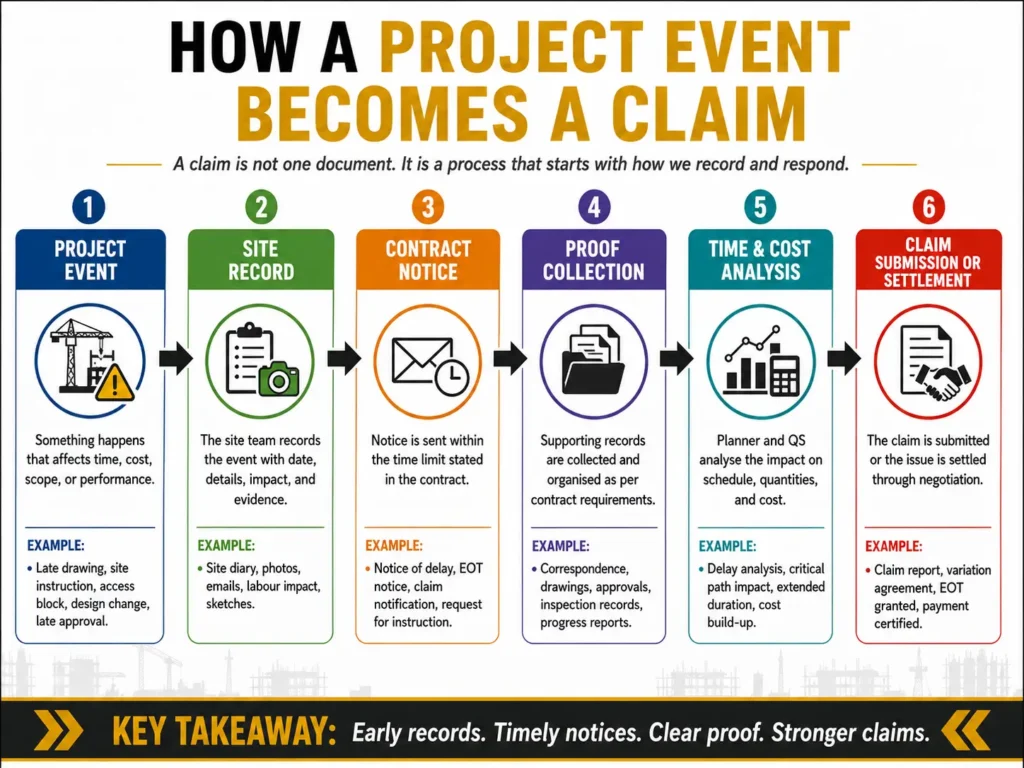
A typical chain may look like this:
- Something changes or blocks the work.
- The site team observes the issue.
- The team records the event, impact, and instruction.
- The right person sends notice under the contract.
- The team collects proof.
- The QS, planner, and contracts team quantify time and cost.
- The project submits or negotiates the claim.
The weak point often sits at steps 2 and 3.
If the site team does not record the event properly, everyone else works with half-truths later. If the planner does not connect the event to the schedule, the delay claim may look weak. If the QS cannot connect the change to quantities or cost, the payment claim may face questions. If the contracts team learns about the event too late, notice timelines may become a problem.
PMI’s construction claim management paper describes claims as a management issue across the project life cycle. It also stresses prevention, mitigation, claim identification, claim quantification, and resolution. That framing matters because claim management does not start after conflict. It starts when the project sets scope, records events, manages changes, and acts on time.
The missed notice problem
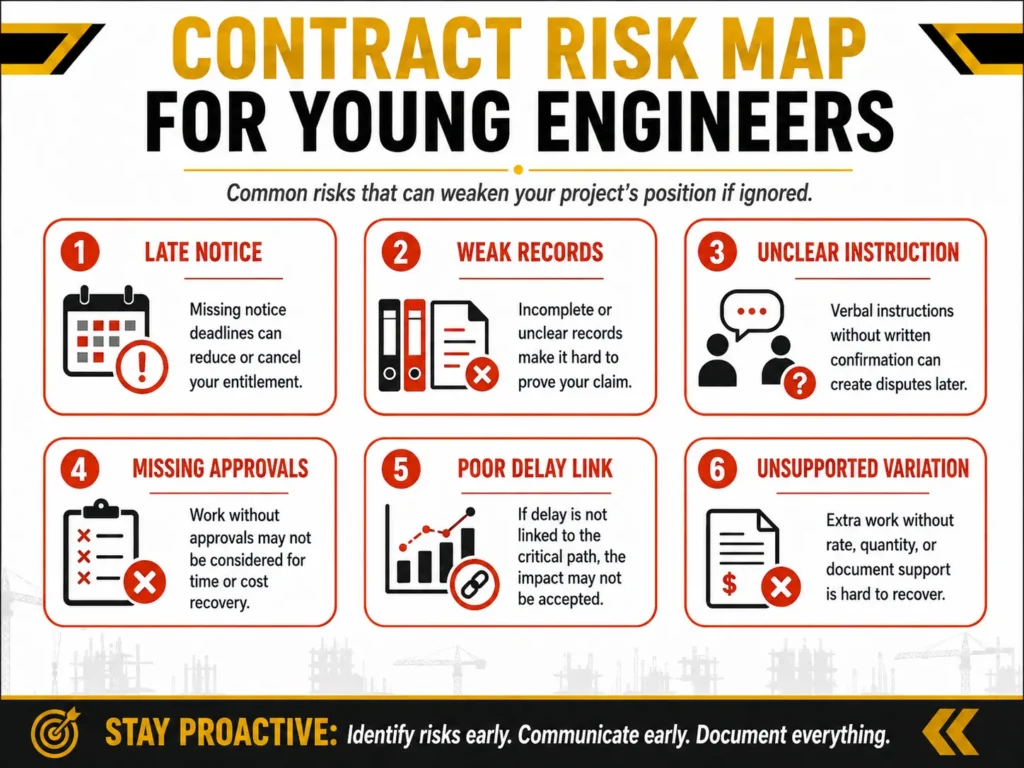
Notice sounds like paperwork until a team misses one.
Picture a project where the client issues revised drawings that affect a major activity. The site team adjusts the work because the project cannot stop. The planner marks delay. The QS keeps the change in mind for later. The project manager expects the client to understand.
Three weeks pass.
Then the team prepares a claim for extra time and cost. The client asks a simple question: “Where is the notice?”
The answer decides the mood of the entire discussion.
A notice does not need to contain the full claim on day one in many contract forms. It often needs to alert the other party that an event has occurred and that the project may seek time, cost, or another contractual relief. The detailed claim can follow with records and analysis. But if the contract demands notice within a specific period, delay in sending notice can weaken or even defeat the claim.
That is why site teams should not treat notices as an afterthought. A delay event, access problem, late approval, design change, extra work instruction, or force majeure-type event may all need early contract review.
Engineers should not decide notice strategy alone. They should alert the right person early.
What engineers must record when things change
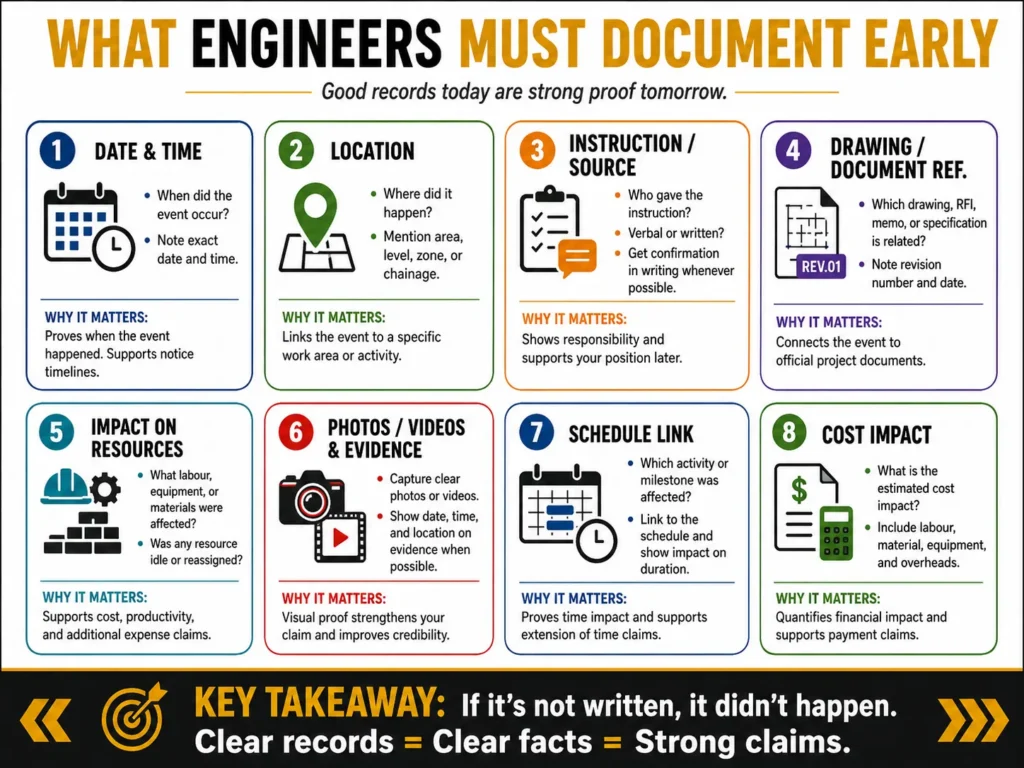
Good records do not need fancy language. They need clarity.
When an event affects time, cost, quality, access, or scope, engineers should capture the basic facts before memory fades.
| What to record | Why it matters |
| Date and time | Shows when the event started |
| Location | Connects the event to a specific work area |
| Drawing or document reference | Links the issue to project records |
| Instruction source | Shows who directed or approved the change |
| Labour and equipment affected | Supports cost and productivity impact |
| Activity affected | Helps the planner connect the issue to schedule |
| Photos or videos | Gives visual proof |
| Follow-up action | Shows how the team responded |
This may look simple. On a live project, people skip these basics because work pressure feels urgent. That is the trap.
A photo without date, location, and context may not help much. A diary entry that says “delay due to client” may not prove anything. A WhatsApp message may show urgency, but it may not replace a contract notice or proper correspondence.
The Society of Construction Law Delay and Disruption Protocol gives guidance on extensions of time and compensation for delay and disruption. It stresses transparency of information and methodology as central to dispute prevention and dispute resolution.
In plain terms: if the project wants fair treatment later, the project needs clear records now.
Variations: where site work and money often separate
Variations create many claims because site execution moves faster than commercial approval.
A client may ask for a change. A consultant may issue a revised drawing. A site condition may force a different method. The contractor may do the work to keep progress moving. Later, the billing or commercial team tries to recover the cost.
Trouble starts when the work has no clean trail.
A strong variation record should answer:
- What changed from the original scope?
- Who instructed or approved the change?
- Which drawing, RFI, or site instruction supports it?
- Which BOQ item applies, if any?
- What quantity changed?
- What time or cost impact did it create?
- Did the team send the required notice or request?
A weak variation record turns into a negotiation based on memory. A strong one gives the team a better chance of fair payment.
This is where engineers matter. The person closest to the work often knows the facts first. If they do not capture them, the commercial team may chase proof later that no one can recreate.
Delay claims need cause, effect, and proof
Delay claims often fail because the team only proves that the project finished late. That does not prove who caused the delay or how the delay affected the critical work.
A useful delay record connects cause and effect.
Cause: “Client approval for reinforcement drawing revision arrived five days late.”
Effect: “Block C slab reinforcement inspection moved from 12 May to 17 May.”
Proof: emails, drawing register, inspection request, site diary, schedule update, labour allocation record.
Contract step: notice or correspondence sent under the relevant clause.
Without that link, the claim may sound emotional rather than factual.
Good planning records help here. The planner should show how the event affected the schedule, not only that work slowed down. The site engineer should show what happened on the ground. The contracts team should connect the event to the contract. The QS or billing team should show cost impact.
A delay claim needs teamwork. No single department can build it alone.
Claims are not always hostile
Many people hear “claim” and think of dispute, anger, or legal fight. That is not always true.
A claim can simply mean one party asks for time, money, or another relief that the contract allows. If both sides agree, the matter may become a variation, extension of time, or contract adjustment. If they disagree, the issue may move toward dispute.
This distinction matters. Engineers should not hide issues because they fear conflict. They should record and report issues so the project can handle them professionally.
PMI’s claim management paper makes the same practical point: when parties agree on a requested change, the claim or dispute can disappear and become a change. Poor handling, weak communication, and missing records can push issues toward dispute.
A well-managed claim process can protect relationships because it replaces blame with facts.
Contract awareness for each engineering role
Different engineers touch claims in different ways.
| Role | How the role affects claims |
| Site engineer | Records site events, instructions, access issues, delays, and actual work done |
| Planning engineer | Links events to schedule impact and recovery plans |
| QS / billing engineer | Quantifies cost, quantities, variations, and payment impact |
| QA/QC engineer | Maintains inspection records, NCRs, approvals, and quality evidence |
| Procurement engineer | Tracks late materials, vendor delays, and approval issues |
| Project manager | Decides escalation, strategy, and negotiation direction |
| Contracts engineer | Connects records to clauses, notices, entitlement, and claim submission |
This is why contracts and claims should not remain a specialist topic. Every engineer who creates project records plays a part.
What young engineers should learn early
A young engineer does not need to master construction law in the first year. They should start with practical contract habits.
Learn the project’s scope. Know what work the contract includes and what may count as extra. Learn the notice process. Know who must receive notices and how quickly the team should act. Keep clear site records. Do not depend on memory. Connect records to drawings, instructions, dates, and locations. Escalate early when something affects time, cost, access, or quality. Ask the contracts or commercial team before the issue grows.
These habits protect the project. They also make an engineer more valuable.
A site engineer who understands records becomes useful to billing. A planner who understands notices becomes useful to claims. A QS who understands site facts becomes useful in negotiation. A contracts engineer who understands actual work becomes stronger than someone who only reads clauses from a desk.
Final takeaway
Contracts and claims do not sit outside engineering work. They grow from daily project decisions, site records, drawings, approvals, delays, variations, and communication. An engineer who ignores contracts may still do the work well, but they may leave the project exposed when time, money, or responsibility comes under question.
The best engineers do not turn every issue into a fight. They notice risk early, record facts clearly, alert the right people, and help the project protect its position before memory fades and deadlines pass.
For learners who want to grow into site leadership, QS, billing, planning, contracts, claims, project controls, or commercial management,Construction Learning offers a focused way to build role-based construction skills. Strong careers do not come from certificates alone. They come from understanding how real construction work connects to time, cost, records, and responsibility.
References
- FIDIC 1999 Red Book Sub-Clause 20.1 reference
https://www.i-law.com/ilaw/doc/view.htm?id=355541 - FIDIC 2017 claims process overview
https://www.diales.com/en/global/news/the-claims-process-under-fidic-2017-from-a-contractor-s-perspective - PMI: Construction project claim management
https://www.pmi.org/learning/library/construction-project-claim-management-7582 - PMI: Furnishing evidence for construction contract claims
https://www.pmi.org/learning/library/evidence-construction-contract-claims-attorney-1756 - RICS: How claims under contract differ from those for breach
https://ww3.rics.org/uk/en/journals/construction-journal/claims-under-contract-versus-breach-contract.html - Society of Construction Law: Delay and Disruption Protocol
https://www.scl.org.uk/resources/delay-disruption-protocol